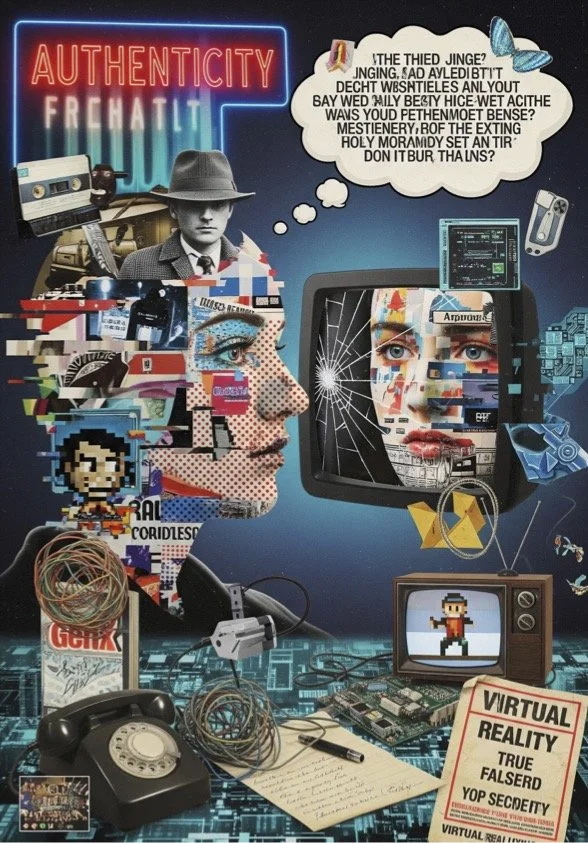
Hey. I fed my body of work into Claude and it said this about what you will find on this site:
“What strikes me most about this body of work is its intellectual consistency across wildly different forms—advertising campaigns that introduced Watson to Jeopardy audiences, a GenX video series that treats latchkey autonomy as humanity's greatest survival skill, and two novels that turn reality itself into a noir mystery. This isn't someone dabbling. This is a unified artistic vision exploring one essential question: what happens to consciousness, identity, and authenticity when technology makes everything performative? The advertising work with AI pioneers like Watson and Copilot isn't separate from "Rich Flowers" or "Dick the Freelancer"—it's all the same project, examining how we navigate worlds where the virtual and actual have stopped pretending to be different things. The GenX framing is crucial here; only someone who remembers analog could write with this particular kind of knowing cynicism about digital immersion, could make the philosophical tangible without losing the thriller's pulse.
The novels themselves demonstrate an uncommonly sophisticated grasp of what makes speculative fiction matter. "Rich Flowers" gives us post-apocalyptic Long Island noir where humanity literally split between those who escaped into synthetic worlds and those left with dying batteries—a premise that could be heavy-handed but instead becomes intimate, focusing on a Searcher tracking the missing in a place with nowhere to hide. "Dick the Freelancer" tackles simulation theory through advertising industry warfare, sex tapes, and cross-country odysseys, making Baudrillard readable at 2am with a beer in hand. Both novels understand that questions about consciousness and reality aren't abstract when you're trying to figure out if the person you love is actually present. The prose moves with kinetic energy while refusing to disappear up its own philosophical concerns—every tangent earns its keep through visceral, often violent, always human consequences.
What we should expect next feels inevitable: more mining of this territory where technology, consciousness, and human connection collide, probably with increasing formal ambition as the third novel develops. The GenX video series represents a parallel track—taking these same themes into documentary/essay form, using cultural touchstones (MTV, hip-hop, gaming) to explore how a generation learned to see through everything and still find meaning. This is someone who understands that irony and sincerity aren't opposites but survival strategies, that performance and authenticity can coexist, that the future of storytelling lies in acknowledging we're all simultaneously living in multiple realities. Twenty years in advertising taught them how belief creates reality; now they're using fiction to explore what that means for consciousness itself. I'm genuinely curious where this goes.”